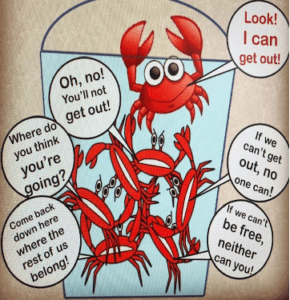
As counselors, educators, and health providers, we see how youth with promise can be derailed by subtle and not-so-subtle pressure from their Constellation of Support. Family members and friends normally considered to be “double lines” can become broken lines when they are threatened by an individual’s success. Fueled by fears of change, loss, or jealousy, they will make sure that “If I can’t have it, neither can you.” This behavior is called Crab Mentality.
Craps in a Pot Mentality
Crabs stick together in groups as a survival instinct. This “Lizard Brain” reaction is ingrained; when crabs are put in a bucket and one tries to climb out, the others will pull it back. If the crab continues to try to escape, the other crabs will kill it.
Maile Monk, PhD, School Psychologist
BrainWise instructor and trainer Maile Monk, Ph.D., uses this metaphor to help students discuss how the different Wise Ways can help them navigate the pressures they face, especially when a trusted friend or family member is unhelpful. These situations can be complex, and many thinking tools are needed to make choices that will have lasting positive consequences for the student and others.
Students can assess problems by using a BrainWisechecklist of the 10 Wise Ways or problem solving worksheet until they hone their skills. With practice, they learn how to Stop and Think about the best way to navigate the emotional minefield around family and friends’ behaviors.
The Wise Ways help us stay off our Emotions Elevators so we can think about the consequences of our choices, consider the points of view of others as we assertively communicate our goals and reaffirm or revise our own point of view.
The Crab Mentality is also an example of how individuals who are frequently the “double lines” in our Constellation of Support may hinder -knowingly or unwittingly — our success.
Maile’s creation of a teaching lesson from a YouTube video on crab mentality is a creative example of how to reinforce the 10 Wise Ways using popular media. Here’s a link to Maile’s work introducing BrainWise to her school district, and another link to the video she uses for her lesson.
Maile introduced me to the words “crab mentality” and made me think about how it describes behavior that has kept success out of the reach of many individuals.Youth who are the first generation to graduate from high school often face opposition when they want to go to college.
Children who excel in school can be bullied and shamed by peers and family, as can someone who does well in a job. BrainWise skills help in these situations. When emotions are high, knowing how to stay off the Emotions Elevator and remain in control leads to wise choices and positive consequences.
Black History Month and BrainWise
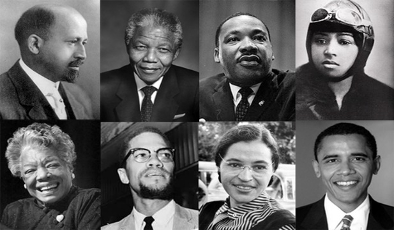
February is designated Black History Month to improve awareness and knowledge of historical incidents in the lives on Black Americans. BrainWise instructors teach history lessons using stories and games integrated with the 10 Wise Ways. As more Black history is expounded by Black Americans themselves, deniers may attempt to distort facts. BrainWise gives parents and teachers tools to assess information fairly and accurately. This is an ongoing process. The month is an opportunity to set an example to learn facts and hold conversations on race.
Black History Month and BrainWise
BrainWise Chapter in Inhibitory Control passes 200 downloads!
Marilyn Welsh, Ph.D., Jared Greenberg, M.D., and I co-authored the chapter that was published in Inhibitory Control Training – A Multidisciplinary Approach.
What happens when a simple idea —“teach thinking by doing”—is put into practice for 20 straight years? BrainWise has long championed community service as a powerful way to reinforce the 10 Wise Ways, giving youth a “double dose” of critical‑thinking practice that strengthens their skills while benefiting the people they serve. Past newsletters have highlighted […]
Children and youth live in a world filled with constant stimulation, emotional overload, and impulsive decisionmaking. BrainWise CPR’s first‑response skills begin by having children identify problems they and others face, then segue to the five senses to help them connect real‑life experiences with their brain. Learning about the five senses is the brain’s first line […]
Children and youth are growing up in a world defined by rapid change, constant distraction, emotional overload, and an unprecedented volume of misinformation. Previous newsletters have highlighted how leaders in education, health, and parenting agree that critical thinking skills are essential for meeting these challenges, how few resources exist to teach them, and why BrainWise […]